Fifty-nine — Bye, Tenhou
2023/12/28 - 2026/4/10
First Encounter (2023/12/28 - 2024/1/15)
Like most Riichi Mahjong players, before I got into Tenhou, I first started with Mahjong Soul. But how did I even come across Mahjong Soul in the first place? That goes back to a recommendation from one of my undergraduate roommates. He told me that Riichi Mahjong, once you understand it, is much more interesting than Sichuan Mahjong. So one day at an internet café, I opened Mahjong Soul—and won my first tanyao.
If we trace it one step further, how did my roommate discover Mahjong Soul? That, I have no idea. Maybe he watched Saki or Akagi, or maybe he was just attracted by the character skins. As for me, whether the skins looked good didn't matter at all (which also meant the main monetization point had zero effect on me). Instead, one late night, after watching Mahjong Soul crash and reload again and again in Safari on my iPhone X, I realized—it was time to find a replacement.
So I recalled that when I was stuck at Adept 3 in Mahjong Soul, I had searched online for improvement guides. Maybe I came across Coach Duan Hao's answer mentioning Tenhou. Its extremely minimalistic—even somewhat "haunting"—UI perfectly matched my preference for simplicity. I played a few games, noticed that my laptop fan didn't even spin up—and just like that, I switched to Tenhou.
At that time, I had already learned both four-player (yonma) and three-player (sanma) Mahjong in Mahjong Soul, so I played both modes in Tenhou as well. From 2023/12/28 to 2024/1/15—likely during my university finals period—I played casually. Since I only had two closed-book exams and they weren't particularly difficult, I had quite a bit of free time outside studying. Online Mahjong added a bit of color to an otherwise plain routine.
Across 22 yonma games and 37 sanma games, my performance in sanma was noticeably better (estimated ranks: 3-dan vs. 1-kyu). The sample size was small, so the absolute numbers didn't mean much, but the tendency was clear. However, after a four-game winning streak in sanma—from 2-kyu to 1-kyu—I then placed third in 5 out of the next 8 games. My interest faded just like that.
After that, I had to deal with IELTS during winter break, competitions in the second semester of junior year, and decisions about my future. Mahjong Soul was played only occasionally, reaching Expert 1 in sanma, while Tenhou was almost untouched.
Struggle (2024/7/17 - 2025/12/6)
July 2024 brought another period of free time. A month or two earlier, I had decided to pursue graduate studies at my current university and had already chosen my advisor, which meant I didn't have to travel around for summer camps. It turned into a perfect summer. I remember that August was extremely hot, so my family went to a nearby place to escape the heat. Naturally, my parents played Mahjong every afternoon.
At that time, I was deeply frustrated by what I believed to be rigged matchmaking in Mahjong Soul. One day I couldn't take it anymore and wrote an article "proving" it. Shortly after that, I stopped playing on that account.
Being reminded of it, I naturally thought of Tenhou again. My previous account had been reclaimed after 180 days of inactivity, so I registered a new one and started over. I played both yonma and sanma again, believing that a few months would be enough to reach Tokujou (upper tables). Instead, I played from 2024/7/17 all the way to 2025/12/6, and failed to achieve that goal in either mode. There's no need for excessive wording here—the data speaks for itself:
- Sanma (969 games):
- 2024/9/16 1-dan (Game 60)
- 2024/9/21 1-kyu (65)
- 2024/10/4 1-dan (83)
- 2024/10/4 2-dan (88)
- 2024/10/17 3-dan (127)
- 2024/10/28 2-dan (206)
- 2025/1/8 3-dan (287)
- 2025/1/20 2-dan (363)
- 2025/2/8 1-dan (419)
- 2025/2/15 2-dan (436)
- 2025/4/15 3-dan (585)
- 2025/6/5 2-dan (674)
- 2025/9/6 1-dan (801)
- 2025/9/19 2-dan (810)
One particularly notable period was during the winter break of 2025, when I dropped back to 2-dan in sanma for the second time. I seriously considered giving up on the Tokujou goal. At that point, my yonma had just reached 3-dan for the first time—only about 600 points away from Tokujou. So I focused on yonma again. From January 19 to February 7, over 28 games, my score only went from 600 to 690 (peaking at 705).
Then on the morning of February 8, after just two games, it dropped back to 615. That meant the effort of the past ten days had essentially evaporated. In the afternoon, I played three more games, finishing 221, and recovered to 705. Not satisfied, I pushed for a new high—only to immediately fall back to 630. After three more games with no change, I kept going and lost another 75 points, dropping to 555—below where I had started.
Meanwhile, sanma dropped from 110 points in 2-dan to 50. I decided to try a kind of aversion therapy: deliberately tank both modes to lose interest entirely. I AFK'd one sanma game and two yonma games, bringing sanma back to 1-dan and cutting yonma down to 305 points.
But the stimulation from sanma was too strong, and this "therapy" wasn't effective. After just one day, I relapsed. Soon, sanma bounced back to 2-dan, and even my Mahjong Soul account reached Gold Room in late May. After nearly 10 months and 600 games, by December, I had grown tired of the endless cycle between 1-dan and 3-dan, and gave up Tenhou for the second time.
Breakthrough (2025/12/15 - 2026/3/16)
Switching back to Mahjong Soul, my attempt to push my sanma rank on my secondary account was far from smooth. Starting from Expert 3 on 2025/10/24, I tried to climb, but by 2026/2/25, I had dropped to Expert 2. My deal-in rate stayed around 13–14%, while my win rate fell below 30%. The worst stretch was from 2/18 to 2/25, where after three third-place finishes, I immediately followed with three fourth-place finishes (33323333), resulting in a demotion. That completely broke my confidence, and I returned to my backup Tenhou account.
That account had been registered on 2024/9/11, and before 2025/12/6, it only had 31 yonma games and 135 sanma games, with ranks around 5-kyu and 1-dan.
I continued focusing mainly on sanma, without expecting too much in terms of reaching Tokujou—just playing to keep my hands warm. The rank progression looked like this:
- Sanma (361 games):
- 2025/3/7 1-dan (Game 59)
- 2025/3/14 1-kyu (65)
- 2025/3/20 1-dan (88)
- 2025/3/23 2-dan (99)
- 2025/6/6 1-dan (130)
- 2026/1/14 1-kyu (174)
- 2026/1/19 1-dan (185)
- 2026/2/23 2-dan (226)
- 2026/3/7 3-dan (257)
- 2026/3/16 4-dan (346)
As you can see, even after restarting on December 15th, my performance initially looked even worse than before (I even dropped back to 1-kyu). But after reaching 2-dan again, something interesting began to happen:
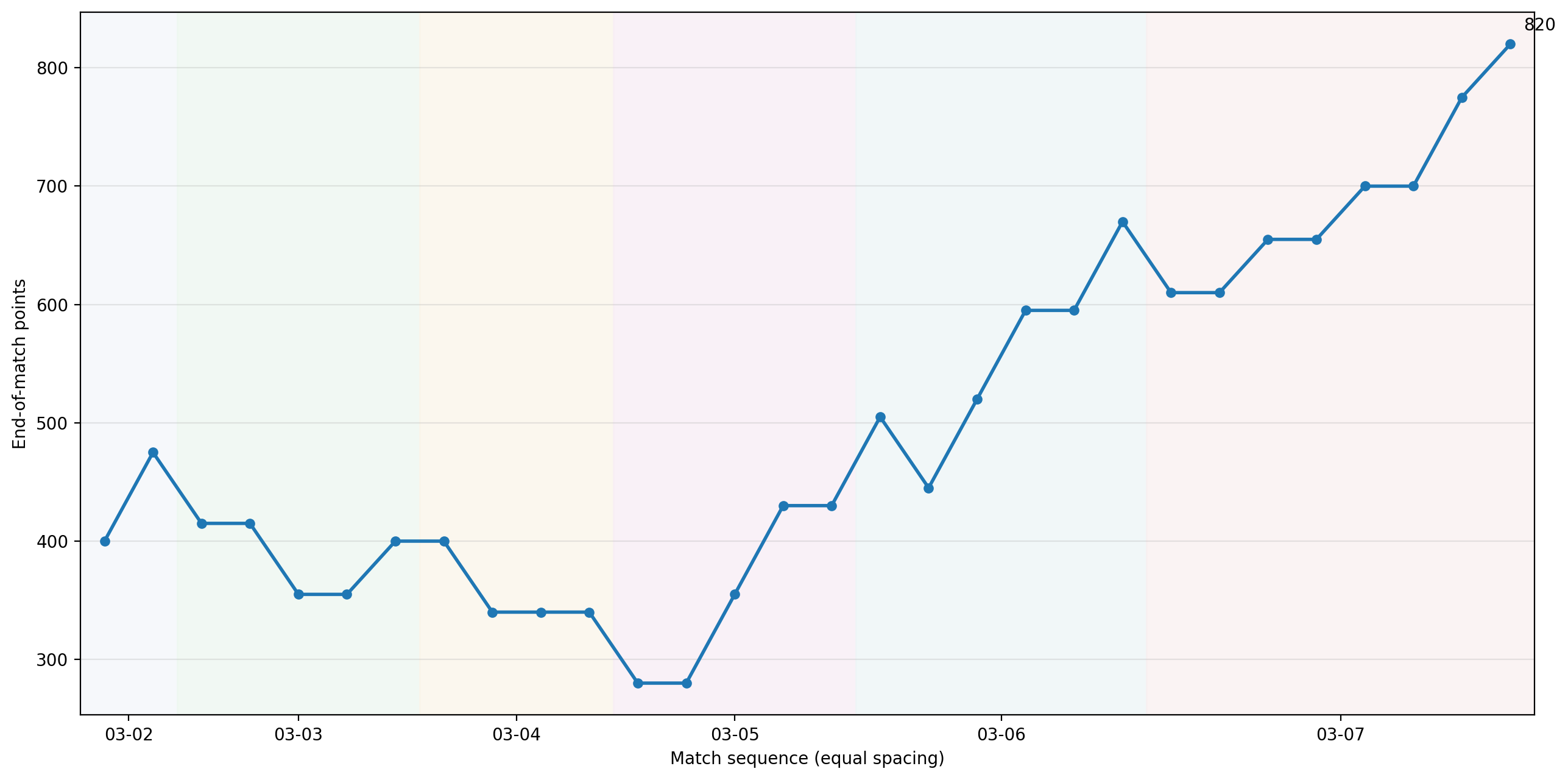
From the chart, starting around March 5, my score began to show a clear upward trend. In just three days, I reached 3-dan, setting a new personal best.
Then came the statistics for 3-dan, where I continued to maintain the momentum:
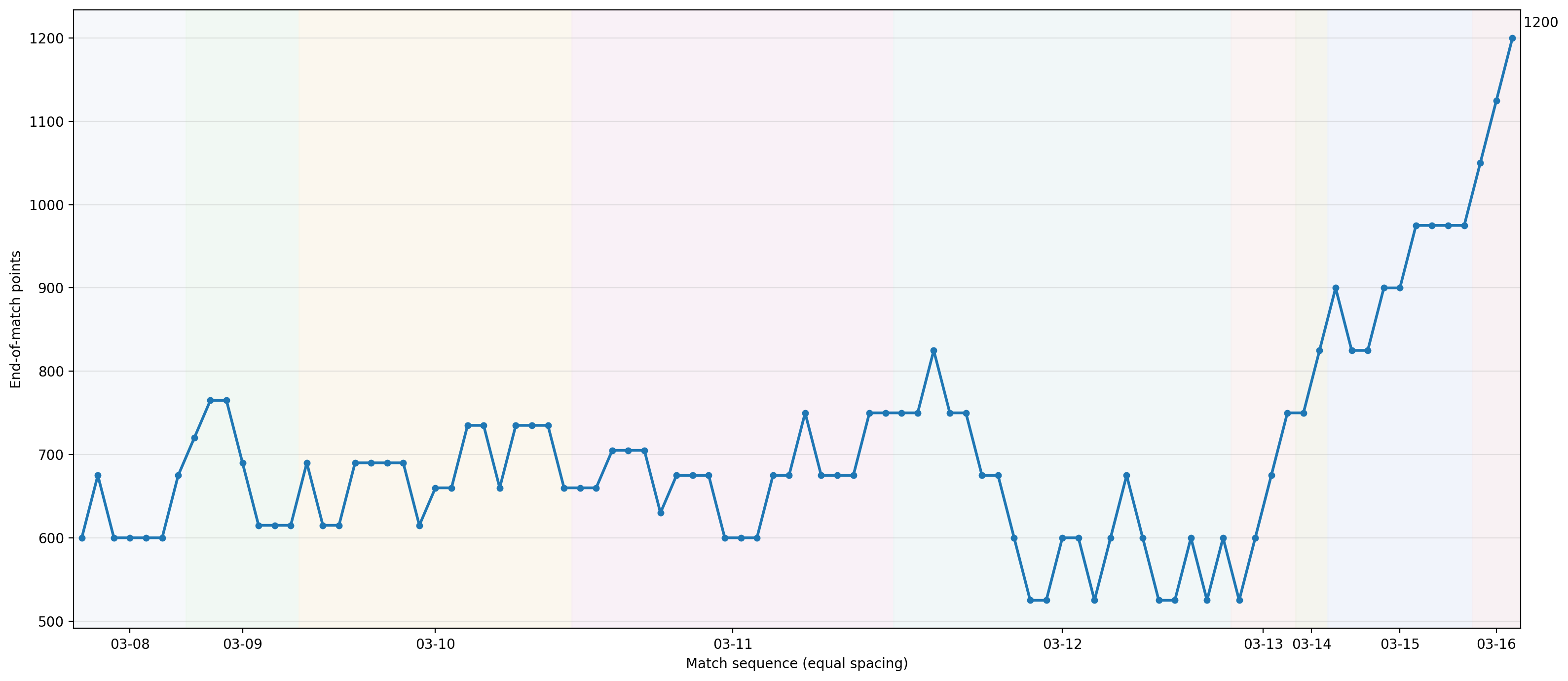
You'll notice:
- In the first 73 games, my score was almost completely stagnant; but in the final 17 games, I climbed and promoted within just four days;
- Looking at a longer timescale, after struggling in sanma for over two years—rising and falling dozens of times—I suddenly went from 2-dan to 4-dan in just about ten days.
It seems that many things in life work this way: most of the time, effort does not immediately translate into results; but at a certain point, what you've accumulated begins to take effect, and things suddenly come together.
However, when I reached 4-dan, my R rating was only around 1760+, still short of the 1800 required for Tokujou. That meant I needed to win a few more games. On March 16, I was quite excited (having never reached 4-dan before), so I played 15 more games in one go (18 games total that day). In the end, I reached R1800 and finally got to experience Tokujou—the goal I had chased for over two years.
Farewell (2026/3/16 - 2026/4/10)
One might ask: why not continue pushing for 7-dan in the Phoenix tables?
Like most competitive games, Riichi Mahjong heavily depends on the precision of your decision-making. But unlike purely skill-based games, luck also plays a significant role in the short term. I don't believe I've reached the level of complete composure required—otherwise, I would have reached 4-dan much earlier. If I kept going, the mental exhaustion from the game would likely outweigh the sense of achievement from eventually reaching Phoenix. So after experiencing Tokujou, I stopped playing sanma.
In fact, after getting used to the high stimulation of sanma, when I went back to yonma, I often couldn't even win a hand for long stretches. Even when I did, it rarely had the same impact—nothing like the frequent mangan or haneman wins in sanma. It all started to feel rather dull. On April 10, after my third account had just reached 1-dan in yonma, I immediately got two last-place finishes. Even the final source of positive feedback disappeared. After that, I simply stopped playing Tenhou altogether.
The process of quitting wasn't as painful as I had imagined. Setting up StayFocusd was enough to keep my hands in check. During the first three days, I would still feel the urge to play at night. When the impulse came, I would chat with GPT, and after about 10–30 minutes, the craving would noticeably fade. After about a week, the intensity of the urge dropped by roughly half—though of course, one still has to stay cautious afterward.
That said, I won't go as far as to say I've quit Mahjong entirely. I still play Sichuan Mahjong with my family, and Mahjong Soul with old friends. That's why the title is only "Goodbye, Tenhou."
In life, many things seem to disappear just like this—quietly, without much drama.
Appendix
Here is a summary of the five accounts mentioned in this article:
- Mahjong Soul (main): 2023/10/10 - 2024/09/17, 331 yonma games, 346 sanma games
- Mahjong Soul (secondary): 2023/10/16 - 2026/03/23, 103 yonma games, 460 sanma games
- Tenhou (first account): 2023/12/28 - 2024/01/15, 22 yonma games, 37 sanma games
- Tenhou (second account): 2024/07/17 - 2026/03/28, 271 yonma games, 969 sanma games
- Tenhou (third account): 2024/09/11 - 2026/04/10, 76 yonma games, 361 sanma games
In total: 803 yonma games and 2173 sanma games. Assuming an average of 25.3 minutes per yonma game and 12.9 minutes per sanma game (based on statistics from my second Tenhou account), that amounts to approximately 805.79 hours spent reaching Tokujou—which is fairly close to Coach Duan Hao's expectation of around 1000 hours.
Easter egg: I thought this number of games was already quite a lot. But then I realized that some people have played over 70,000 sanma games across more than 9 years—truly inhuman. It really shows how addictive this game can be.